
Shopify & WordPress Development
Shopify integration services that connect your store to your ERP, suppliers, warehouses and finance tools, and take repetitive work off your team.
What you get
Behind most busy Shopify stores is a person copying data between systems. Orders get keyed into the ERP, stock counts come in as a supplier spreadsheet, refunds are reconciled by hand in Xero at month end. It works until volume grows or that person goes on holiday.
Our Shopify integration services replace that copying with software that runs on its own and tells you when something needs attention. We connect Shopify to NetSuite, QuickBooks, Xero, 3PLs, supplier feeds, Google Sheets and Slack, and we automate the decisions that follow simple rules: routing orders, tagging customers, holding risky orders, updating prices.
We have solved a version of this for ourselves. FeedGuard, our supplier feed app, syncs stock and prices from CSV, FTP and Google Sheets into Shopify, so we know how messy supplier data gets and how carefully bulk updates must respect rate limits.
Sometimes Shopify Flow, Make or Zapier is enough, and we will tell you so. When the logic is complex, the volume is high or failures are expensive, a custom integration is the safer choice. Automation that spans the whole business, beyond the store, falls under our AI business automation service.
The problem
A typical example: a homewares brand sells on Shopify, keeps stock in two warehouses and a 3PL, and runs finance in Xero. Every morning someone downloads supplier stock files, updates quantities, exports yesterday's orders for the warehouse and checks for orders that look suspicious. That is easily two hours a day, and mistakes show up as oversells or late shipments.
Off-the-shelf connectors help, but they often fall short in the same places. They cannot handle your SKU mapping, they fail silently when the other system is down, or they sync everything when you only want certain locations or product types.
A well-built integration does three things: it moves the data reliably, it handles the exceptions you care about, and it makes failures visible so they are fixed the same day rather than discovered at stocktake.
What we build
Orders, customers, refunds and payouts sent to NetSuite, QuickBooks or Xero in the format your finance team expects, with stock and prices flowing back.
Stock and price updates from supplier CSV, FTP, API or Google Sheets, with SKU mapping, validation and safeguards against a bad file zeroing your stock.
Send orders to the right warehouse, 3PL or dropshipper by stock, destination or product type, and push tracking numbers back to Shopify.
Hold orders that match risk rules, such as mismatched addresses or unusual quantities, and alert staff in Slack. Plain rules are often clearer than AI here.
Tag, segment and approve customers automatically, sync B2B accounts with your CRM, and trigger follow-ups in HubSpot or Klaviyo.
Push sales, margin and inventory data to Google Sheets, Postgres or a BI tool on a schedule, so reports are ready without exports.
Scenarios
Three suppliers send stock files in different formats at different times. An integration normalizes them, maps supplier codes to Shopify SKUs, applies a safety buffer and updates inventory hourly. For simpler cases our FeedGuard app does this without custom code.
Each paid order becomes a NetSuite sales order within minutes, with the right subsidiary, tax codes and customer record. Failed orders land in a queue with the error message, and staff can retry them with one click.
Bulky items ship from the brand's own warehouse while small items go to a 3PL. The integration splits orders by product type and location, sends each part to the right place and reports back tracking.
Refund requests above a threshold, or from customers with frequent returns, are flagged for a manager in Slack. Return Intelligence covers rules-based return risk scoring; a custom flow can connect those flags to your approval process.
How we build it
The difference between an integration that works in a demo and one that works for years is mostly in how it handles bad days.
We use Shopify webhooks for speed, verify their signatures, and make every handler idempotent because events can arrive twice or out of order. A scheduled reconciliation job then compares both systems and catches anything a webhook missed.
The Admin GraphQL API limits how much work an app can do per second. We batch updates, use bulk operations for large syncs, and queue work so a 20,000-variant price update finishes reliably instead of failing halfway.
Every sync writes to a log your team can read. When something fails, such as an unknown SKU or an ERP that is down for maintenance, it is retried, and if it still fails, someone gets a Slack or email alert with enough detail to act.
Not every automation needs custom code. Shopify Flow handles many simple triggers, and n8n or Make suit lightweight multi-step jobs. We use custom services when volume, complexity or cost of failure justifies it. If you need a new interface inside the admin as well, that is closer to custom Shopify app development. Our ecommerce solutions page shows how this fits with the rest of a store's operations.
FAQ
If they handle your case reliably, yes. Flow is free on many plans and good for simple triggers. Custom integrations make sense when you need complex mapping, high volume, careful error handling or logic those tools cannot express.
We commonly work with NetSuite, QuickBooks, Xero and various 3PL and warehouse systems. If a system has a documented API, or can at least exchange files over SFTP, we can usually integrate with it.
Work is queued and retried automatically. If it keeps failing, your team gets an alert, and nothing is lost because every pending item stays in the queue until it succeeds or someone resolves it.
Any sync has a delay, so we design around it with safety buffers, sync frequency that matches your sales volume, and checks that refuse obviously wrong data such as a feed that sets every product to zero.
Hosting for a typical integration is usually a small monthly cost, plus any fees from the other systems' APIs. We give you an estimate during scoping, and we can include monitoring and upkeep in a maintenance plan.
List the systems involved, what you copy by hand today and roughly how many orders you process. We will suggest the simplest setup that does the job reliably, whether that is Flow, an existing app or a custom integration.
We pick tools for your situation, not ours. These are the ones we reach for most on this kind of work.
How we designed a Shopify app that syncs supplier stock and prices from any file or API, shows a diff before writing, and refuses to import files it doesn't trust.
Read the storyHow we turned a Google Form, a serial-number spreadsheet and a claims inbox into one Shopify app that registers units, issues coverage and resolves claims with real Shopify objects.
Read the storyHow we built a deterministic, explainable rules engine that scores Shopify return and refund requests, shows the reasons behind every score, and never declines a customer automatically.
Read the storyWe don't just build for clients. These are our own products, used by real stores. See all products.

Turn your products into beautiful PDF catalogs, brochures & wholesale line sheets.
Return abuse, explained — not just flagged. Score every return and refund 0–100, see exactly why, and decide with your team in control.
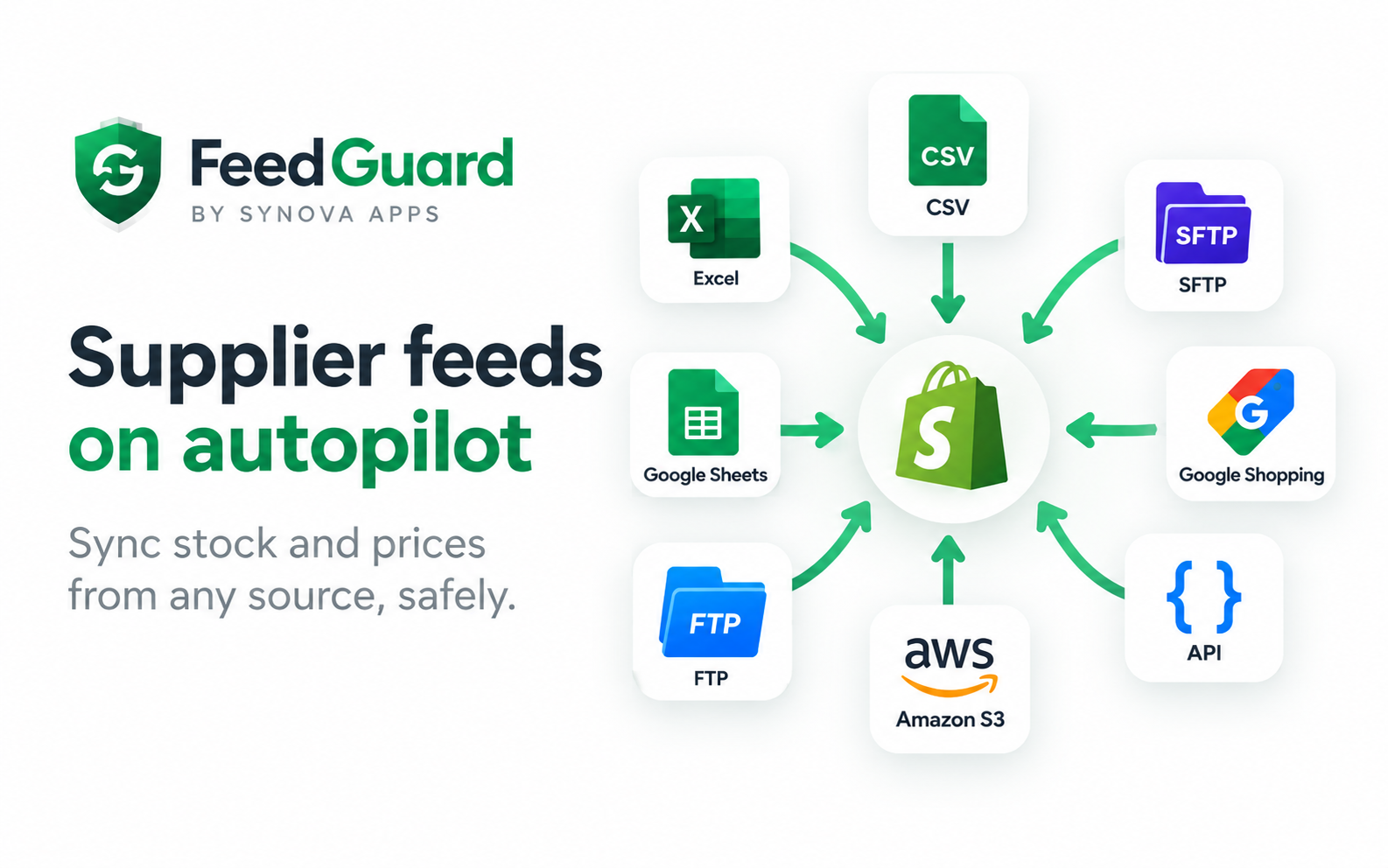
Supplier feeds on autopilot — without the fear. Sync stock and prices from any source, safely.
Turn WooCommerce into a B2B quoting machine — let customers request prices, negotiate, and pay, all in one flow.
Tell us how it works today. We'll tell you honestly what's worth automating, what it would take, and what it would cost.